
City Destinations Alliance Explores the Future Role of DMOs in an AI-driven World
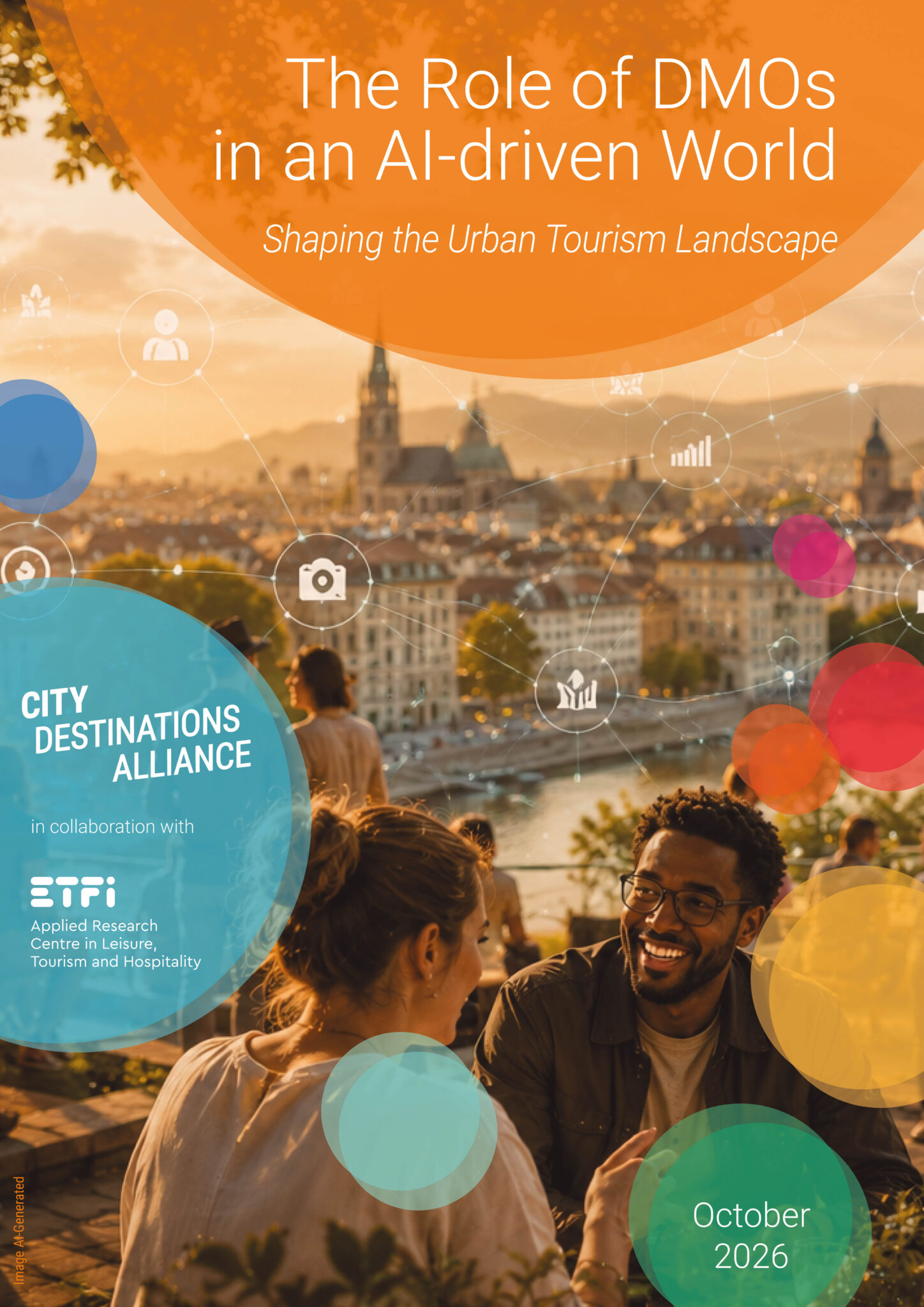
City Destinations Alliance (CityDNA) has released its latest Trend Room Whitepaper, The Role of DMOs in an AI-driven World, exploring how artificial intelligence could reshape European urban tourism by 2031. Through four future scenarios, the publication challenges Destination Management Organisations (DMOs) to rethink their role, safeguard local value and prepare for a visitor economy increasingly influenced by algorithms and global technology platforms.
Developed by the CityDNA Trend Room Knowledge Group in collaboration with the European Transformative Futures Institute (ETFI), part of NHL Stenden University of Applied Sciences, this fourth whitepaper follows previous studies on the metaverse (2023), the traveller of tomorrow (2024) and climate change (2025).
As AI transforms how travellers discover, plan and experience destinations, the study raises a fundamental question: Who will shape the future of urban tourism: destinations, travellers or algorithms?
“AI is fundamentally changing how travellers discover and experience our cities, but destinations must remain active players in shaping that transformation. The challenge for DMOs is not simply to embrace new technologies, but to retain their influence, protect local interests and ensure that innovation creates value for both residents and visitors. Whatever the future holds, people and communities must remain at the heart of our visitor economies,” said Barbara Jamison-Woods, President of City Destinations Alliance.
Four scenarios for 2031
Based on a collaborative scenario-planning process involving 30 CityDNA members, the research, authored by Carolin Giarra and facilitated by Dr. Stefan Hartman and Carolin Giarra from ETFI, explores two critical uncertainties: human versus AI-driven travel experiences, and AI ecosystem control.
Four plausible futures emerge:
- Go with the Algorithm: AI-driven travel flourishes within a diverse ecosystem of competing technologies.
- Free to Roam: AI supports travel planning, while human interaction and spontaneous discovery remain central.
- Off the Beaten Algorithm: Dominant platforms control travel discovery, while authentic local experiences gain value.
- All Roads Lead to AI: A handful of AI platforms influence nearly every stage of the visitor journey.
“The question is no longer simply how destinations can use AI, but how much influence they will retain as AI increasingly shapes travel decisions. Our scenarios highlight that technological progress does not automatically translate into better destination management. DMOs need to understand the different futures they might face and make conscious choices about the role they want to play. This is where strategic foresight becomes essential, helping destinations challenge assumptions, anticipate change and embed future-oriented thinking more systematically into their strategies and decision-making,” said Carolin Giarra, Researcher at European Transformative Futures Institute (ETFI).
What it means for DMOs
The whitepaper identifies five strategic priorities relevant across all scenarios: building AI capabilities, treating destination data as strategic infrastructure, safeguarding local participation, strengthening authentic human experiences and anticipating AI-driven changes in visitor flows.
“Our discussions at the recent CityDNA Autumn Conference in Verona showed that while AI is becoming an unavoidable part of the visitor journey, human connection and local experiences remain essential to what makes destinations unique. The aim is not to predict which scenario will prevail, but to help DMOs prepare for different possibilities. By strengthening their AI capabilities, destination data and local partnerships, they can remain relevant and resilient, whatever direction technology takes,” said Davy Jansegers, Chair of the CityDNA Trend Room Knowledge Group and Head of Business Development at Lausanne Tourisme.
Keeping people at the centre
Available exclusively to CityDNA members, the whitepaper delivers a broader message: the future of tourism should not be determined by technology alone. Through strategic foresight and collaboration, DMOs can ensure that AI strengthens the human connections and local identities that make European cities unique.
For destinations looking to shape the future of Europe’s visitor economy, CityDNA offers a community in which to exchange knowledge, access exclusive research and connect with peers facing similar challenges. Beyond this latest Trend Room Whitepaper, members will benefit from the upcoming CityTax Project Whitepaper, due for release by the end of 2026, as well as a programme of dedicated events, including the 2nd CityDNA CVB Expert Meeting in Timișoara (January 26-27, 2027), the 20th CityDNA CEO Meeting in Luxembourg (February 1-2, 2027), and the CityDNA International Conference & General Assembly in Bremen (April 14-16, 2027).
Destination organisations not yet part of the Alliance are invited to join CityDNA to gain access to exclusive knowledge and insights, connect with a European network of peers, contribute to collective discussions and actively shape the future of Europe’s visitor economy.
Discover the benefits of CityDNA membership and become part of the Alliance at citydestinationsalliance.eu.
……………………………………………………………………………………………………………
About City Destinations Alliance (CityDNA)
We are a knowledge sharing network for cities and urban regions collaborating to maximise the potential of the visitor economy. Our vision is for all cities in Europe to flourish as great places to live, work, meet and explore. As a community of professionals, our promise to each other is to always be curious and forward thinking, share our inspiration and continued learnings.
For more information and pictures, please contact:
Bénédicte Lack, press@citydna.eu, +33 380 56 02 03
citydestinationsalliance.eu